
In India, certified forensic accounting professionals are individuals who have earned a professional certification in forensic accounting and who work in India. Though the certification is open to all students of all streams there is an eligibility criterion.
A forensic accountant is a professional who uses accounting skills to investigate financial fraud and other white-collar crimes. They may also be called upon to assist in legal proceedings, such as divorce or bankruptcy cases, where financial information needs to be examined in detail.
Forensic accounting is increasingly positioned at the intersection of accounting, auditing, financial investigation, fraud detection and legal proceedings. As organizations face increasingly sophisticated financial frauds, professionals who can examine financial records, identify irregularities, analyse evidence and explain complex financial information have become valuable to businesses, regulators, investigators and professional-services firms.
For professionals considering a career in this field, one of the most important questions is:
Who is eligible to become a Certified Forensic Accounting Professional (CFAP) in India?
The Certified Forensic Accounting Professional (CFAP) is a professional certification program offered through the Riskpro Learning ecosystem. The program is designed to develop practical capabilities in forensic accounting, forensic auditing, fraud investigation, financial statement analysis and litigation support. The current CFAP program describes itself as an advanced-level, distance-learning program and states that it was launched in 2006, when structured forensic-accounting education was still at an early stage.
CFAP, or Certified Forensic Accounting Professional, is a certification program offered by Riskpro Learning. The CFAP program is designed to provide individuals with the skills and knowledge needed to excel in the field of forensic accounting.
The program covers various topics related to forensic accounting, including fraud investigation, financial statement analysis, litigation support, and expert witness testimony. The CFAP program also includes practical exercises and case studies to help participants apply the concepts learned in real-world situations.
To become a certified forensic accounting professional in India, an individual would need to earn a professional certification in forensic accounting from Riskpro Learning. Certified Forensic Accounting Professional is endorsed by NSE Academy in association with Riskpro.
They may be called upon to work for law enforcement agencies, regulatory bodies, or private firms, and may be involved in legal proceedings such as divorce or bankruptcy cases. According to Vedant Sangit, Director of Riskpro Learning, more than 2000 students have completed this program and are helping the law enforcement agencies in the country to combat the $180 billion problem.
Eligibility criteria for CFAP
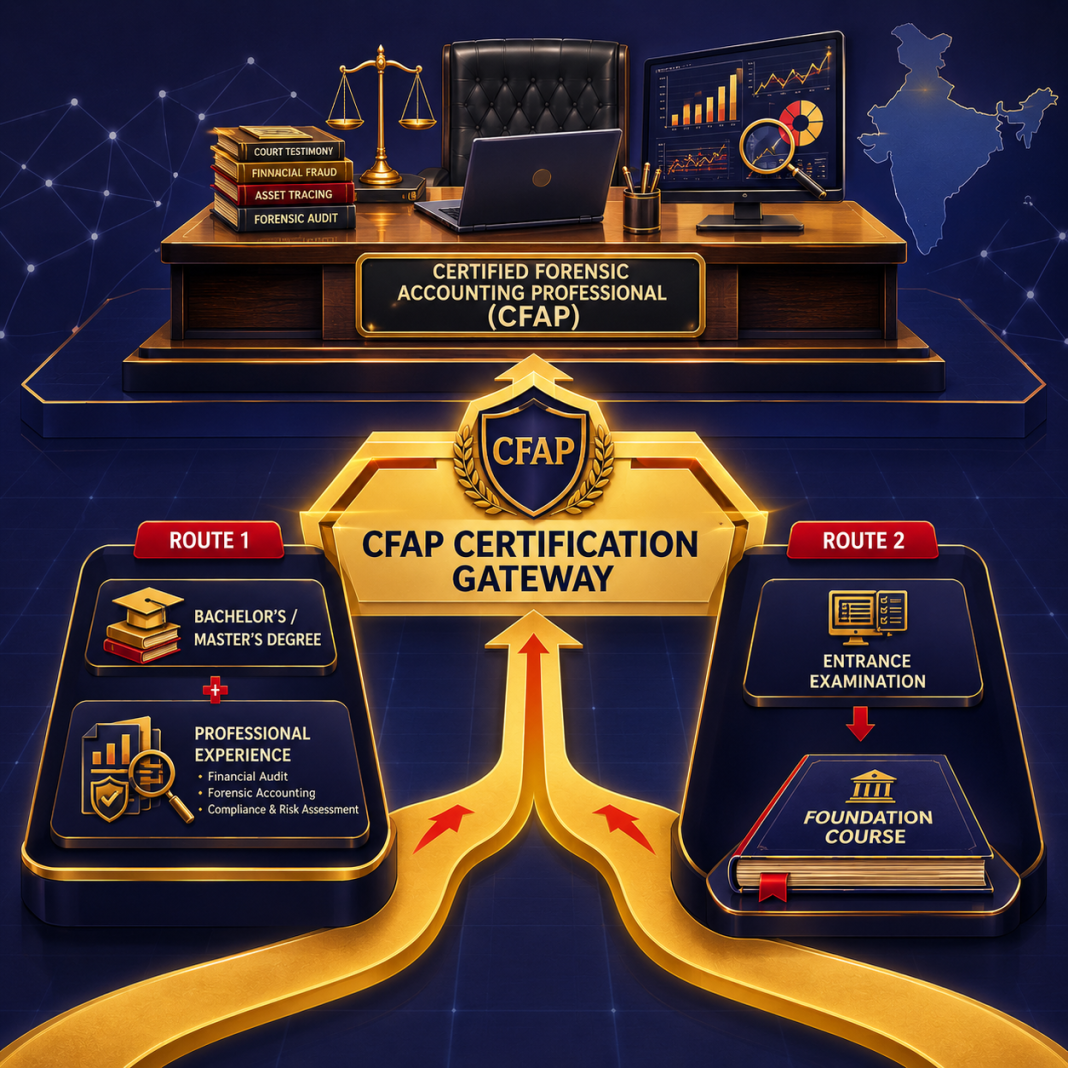
In order to be a certified forensic accounting professional it is necessary to meet the eligibility criterion.
- Meet minimum academic and professional requirements
- Bachelor’s Degree from Recognized University Or
- Master’s degree or Professional Designation
- Should have Professional Experience in the field of finance, accounting, audit, fraud prevention, fraud detection, fraud investigation, information security, analytics or compliance, etc.
- Be of high moral character
Why experience is necessary to be a CFAP?
Certified Forensic Accounting Professional is a specialization. It requires a basic understanding of auditing and financial jargon. Some specific tasks that a certified forensic accounting professional might be responsible for include:
- Examining financial records and documents to identify discrepancies or irregularities
- Analyzing financial data to identify patterns or trends that may indicate fraud or other wrongdoing
- Interviewing witnesses and collecting evidence
- Presenting findings and testimony in court or other legal proceedings
- Providing expert advice and consulting services to clients
A certified forensic accounting professional must have a strong background in accounting and financial analysis, as well as excellent investigative and analytical skills. They must also be able to communicate their findings clearly and effectively, both in writing and orally.
What if you are not experienced?
In case the professional who is aspiring to become a certified forensic accountant does not meet the eligibility criterion then students have to take up the entrance examination. Before taking the examination for Certified Forensic Accounting Professional, a foundation course is necessary.
The entrance examination is the gateway to a career in forensic accounting.
Is CFAP Open to Students From All Academic Streams?
Yes, the broader CFAP eligibility framework is not limited exclusively to students who have studied accounting.
However, being open to candidates from different streams does not mean that every applicant automatically qualifies for the professional certification.
Riskpro Learning’s published eligibility criteria require candidates to meet minimum academic and professional requirements. The criteria specify a bachelor’s degree from a recognised university, a master’s degree, or a professional designation, together with relevant professional experience.
This distinction is important.
A candidate may come from a background in:
- accounting;
- finance;
- auditing;
- management;
- compliance;
- risk;
- information security;
- analytics;
- fraud prevention;
- fraud detection; or
- fraud investigation.
The candidate does not necessarily need to have followed one narrowly defined academic stream.
The focus is instead on whether the candidate possesses the academic foundation and relevant professional exposure required for an advanced forensic-accounting certification.
What If You Do Not Have the Required Professional Experience?
This is one of the most important questions for people considering CFAP.
A lack of professional experience does not necessarily mean that a candidate has no pathway toward forensic-accounting education.
Riskpro Learning’s published eligibility guidance states that candidates who do not meet the experience criterion can take an entrance examination. The guidance also states that a foundation course is required before taking the entrance examination for CFAP.
This provides an alternative pathway for candidates who have the academic foundation but do not yet have the required professional experience.
The entrance route is particularly relevant to candidates who are at an earlier stage of their professional development.
However, prospective candidates should confirm the current admission and entrance requirements directly with Riskpro Learning before enrolling, because certification rules and program structures can change.
Why Is Professional Experience Important for Forensic Accounting?
Forensic accounting is different from conventional academic accounting because the professional is often required to interpret financial information in the context of a specific investigation.
Consider a simple example.
A financial statement may show that a company reported strong revenue growth. A conventional accounting exercise may focus on whether the revenue has been correctly recorded.
A forensic accountant may ask additional questions:
- Where did the revenue originate?
- Are the underlying customers genuine?
- Do invoices correspond to actual transactions?
- Were transactions recorded in the appropriate accounting period?
- Are there unusual related-party transactions?
- Do bank records support the reported revenue?
- Are there unusual journal entries?
- Are there inconsistencies between sales, receivables and cash collections?
- Are there indicators of management override or manipulation?
This investigative mindset requires more than theoretical accounting knowledge.
It requires the ability to connect financial information with evidence, transactions, people, controls and business circumstances.
That is why professional exposure to finance, accounting, audit, fraud, compliance, analytics or related fields can be valuable.