
Home Blog Page 7

Introduction to Fraud Examination and Forensic Accounting

0
Forensic Accounting

What is Fraud?

To grasp the ideas of Fraud Examination and Forensic Accounting, let’s start by understanding what fraud means.

Fraud happens when someone purposely makes another person lose money by tricking them. The trickster usually does this by fooling the victim to take their money or belongings. It’s like a planned, sneaky kind of stealing. Fraud can occur online or in the real world.

The offenses can either be civil or criminal in nature. In the case of civil fraud, the victim files a case against the accused in order to seek the recovery of their lost assets. In the case of criminal fraud, a law enforcement body files a case against the fraudster in order to enforce justice. This is usually in the case of large-scale fraud against companies or many individuals.

The different instances of fraud

Fraud can happen in many different ways. Let me give you a few examples of how fraud can happen:

Consumer Fraud

Bogus companies and fraudsters may defraud people in the name of reliable companies using Pyramid schemes, phishing, telemarketing, and other means. They may also target consumers online by emailing them links that can compromise their private information when opened. The consumers themselves are led to believe that they are taking part in business as usual. However, once they suffer the loss of their assets, they realize that they have been defrauded.

Financial Statement Fraud

Companies may manipulate their financial statements in order to polish their image in the public eye or receive bonuses for meeting certain targets when in reality they haven’t done so. They do this by overvaluing their assets, neglecting to mention expenses and liabilities, adding non-existent revenue, and skewing the timing of entries.

Corruption

Company officials at high levels may engage in taking bribes to appease paying customers. They misuse their power and influence for their personal gain. The demands of the payee, in this case, are almost always unlawful, which is why these under-the-table transactions take place.

Asset Misappropriation

Employees of the company may be misusing the provided assets for their own personal gain. The most common malpractice regarding assets is swiping cash before it is recorded in the company’s systems. Detecting this type of fraud is often quite difficult, as no records exist to unmask the fraudster. Employees may also indulge in check tampering, payroll schemes, fake billing, and inventory manipulation. Asset misappropriation also includes the misuse of company machinery and software for one’s own gain. This means using it for reasons other than for its intended purpose.

Theft of trade secrets

This happens when employees use confidential information for their own gain. It is a form of stealing- robbing the company of its creativity and ideas and taking credit for it. If a person or company steals the intellectual property (such as a recipe, lyrics, or marketing idea) of another company, then it is a type of fraud.

So, now that know what fraud is, it’s time to move on to how to pinpoint it and prosecute the fraudsters. This is where Fraud Examination and Forensic Accounting come in.

Fraud Examination- how to pinpoint a fraudster

Fraud Examination refers to the investigation of potential fraud on the basis of complaints, tips, and other material gathered. A fraud examiner must thoroughly inspect all aspects of the case. He can do this by gathering clues, interviewing suspects, collecting data from witnesses, and going through related documents. He must also take efforts to prevent fraud from occurring in the case that it is yet to happen. Fraud Examiners are expected to both investigate as well as solve potential cases of fraud.

A Fraud Examiner is not the final verdict-taker- he must merely gather all the evidence and present it in a clear, unbiased manner for the judge to take the final decision. The court also expects the Fraud Examiner to present his findings in a comprehensive manner, and testify against the suspects.

Forensic Accounting- analyzing the fraud

On the other hand, Forensic Accounting refers to the investigation done by trained accountants after the fraud actually occurs.

A Forensic Accountant is like a financial detective. They carefully look at financial papers and records to figure out how a scam or trick affected the person who got tricked. These special accountants use their talents to help in catching the bad guys. They study the evidence to understand what exactly happened during the scam and what happened afterwards as a result of it. This helps in taking legal action against the wrongdoers.

Forensic Accountants play a similar role to Fraud Examiners, just on a more technical level.

How are Fraud Examination and Forensic Accounting different from one another?

Fraud Examination and Forensic Accounting are unique and similar in nature. However, there are a few key differences by which we can tell them apart.

The first and most important difference is the timing of the investigation. Fraud Examination is done to prove the occurrence of fraud, while on the other hand, Forensic Accounting takes place after the confirmation of fraud. Fraud Examiners work on the basis of speculation and prediction, while Forensic Accountants work with the guarantee that the fraud has already taken place.

The main goal of the Fraud Examination is to determine who is conducting the fraud and whether it is taking place or not. On the other hand, the job of Forensic Accountants is to determine to extent of the damage caused. They must also come to a conclusion about whether the fraud allegations are in good reason.

The methods used by both parties are also quite different. Fraud examiners use documents, interview eyewitnesses, and access public records to make their claims. Whereas, Forensic Accountants study all financial documents involved in-depth to come to a feasible conclusion.

Though both investigations usually end in litigation, the findings of the Fraud Examiner will determine whether there are to be any court hearings or not, while on the other hand, the evidence collected by Forensic Accountants acts as support in the case of litigation.

The “Certified Bank Forensic Accountant” course from Indiaforensic is a comprehensive training program. It teaches bankers about forensic accounting and fraud examination. This course is really important for those who want to help stop financial crimes happening in banks. It covers a range of topics from bank frauds to cryptocurrency investigations.

Conclusion

So, we can say that Fraud Examination and Forensic Accounting are two sides of the same coin. Both these professionals need to work in harmony with each other to successfully identify fraud and appropriately prosecute the fraudster. Fraud Examination may even be considered a branch of Forensic Accounting. The ultimate goal of the two is to deal swiftly with any instances of fraud and protect victims from it in the future, as well as stop any potential fraud from occurring.


AML In Bahrain

0
Bahrain

Introduction

The AML in Bahrain is crucial aspect now a days. The battle against further money laundering (‘AML’) and terrorism funding (‘CFT’) is a top concern for the National Bank of Bahrain. Bahrain is a participant of the Financial Action Task Force (‘FATF’). This is due to the Gulf Cooperative Authority’s full participation in the FATF. It is devoted to adhering to all global norms in this regard. Bahrain is also a founder participant and host of the regional MENA-FATF secretariat.

The CBB operates an Enforcement Directorate. This is entrusted with managing the CBB’s AML/CFT operations. This is in order to guarantee efficient enforcement with applicable standards. Also to protect Bahrain’s good image as a well-regulated financial hub.

AML in Bahrain

Money laundering is still a concern in Bahrain. The Anti-Money Laundering Unit (AMLU) received the most Suspicious Transaction Reports (STRs) ever since its creation in 2007.

The Bahraini administration passed an anti-money laundering (AML) legislation in January 2001. It makes laundering of funds from any underlying offense illegal. Accused money fraudsters and anyone who helps or facilitates them face up to seven years in jail. They will also be charged with a penalty of up to one million Bahraini dinars (BD). If there is an organized illegal relationship, bribery, or concealment of the source of earnings. A punishment of at least 100,000 dinars and a jail time of at least five years are the statutory penalties.

Importantly, the AML statute authorizes Bahrain to pursue a financial laundering breach. That is even if the conduct is not a financial crime in Bahrain. For instance, there is zero income tax in Bahrain. But anybody engaged in unlawful monetary operations for the aim of dodging another country’s taxation structure may be convicted in Bahrain for financial laundering.

Bahrain Monetary Agency

following the latest passage of the bill, the Bahrain Monetary Agency (BMA), the country’s federal bank’s primary finance industry watchdog, released guidelines mandating financial companies to submit Suspicious Transaction Reports (STRs). This is to keep information for a five-year period. Account credentials should also be easily accessible to law investigation agents. Those who identify fraudulent activity are immune from illegal or civil prosecution. There is no minimum threshold for filing an STR.

Furthermore, the legislation calls for the establishment of the Anti-Money Laundering Unit (AMLU) as Bahrain’s Financial Intelligence Unit (FIU). The AMLU is located inside the Department of the Interior. It has the authority to accept allegations of financial laundering violations. Also to undertake preparatory examinations. They carry out processes linked to multinational collaboration in accordance with the legislation. Also, to carry out rulings, judgments, and decisions made by appropriate authorities in cases involving financial laundering. In July 2003, the AMLU joined the Egmont Group of FIUs.

In 2021, the AML statute was updated.

Compliance with FATF Recommendations

The Financial Action Task Force (FATF) conducted the most recent Mutual Evaluation Report on the execution of anti-money laundering and counter-terrorist funding requirements in Bahrain. Based on the assessment, Bahrain was found to be Compliance for 8 of the FATF’s 40 guidelines, and Compliance or Nearly Compliance for 26 of them. It received an Extremely Efficient rating for 0 and a Significant Efficient grade for 3 of the Efficiency and Technical Compatibility categories.

US Department of State Money Laundering assessment (INCSR)

According to the US Ministry of State’s 2016 International Narcotics Control Strategy Report, Bahrain is a Jurisdiction of Concern (INCSR). The following are the review’s major discoveries: –

Bahrain is the Arab area’s main economic capital. Service-based financial system evolved in Bahrain. The financial industry accounts for around 18% of GDP. It is home to a varied range of financial companies. It comprises 113 licensed banks, 19 financial intermediaries, and a number of other financial organizations, including 151 insurance companies. The biggest danger of money laundering comes from criminal earnings of immigrant provenance passing through the nation. Bahrain’s extensive financial infrastructure, as well as its position as a transportation hub throughout the Gulf and into Southwest Asia. It has the potential to encourage financial laundering operations. Bahrain has no substantial black marketplace for stolen items or recognized ties to narcotics smuggling.

Bahrain’s main harbor, Khalifa bin Salman Harbour, has a special movement corridor. This is to promote duty-free imports of equipment and infrastructure. The North Sitra Commercial Estate also has a free zone. Raw commodities destined for refining in Bahrain, as well as equipment supplied by Bahraini-owned companies, are duty-free. Duty-free storage is available for foreign products. These free regions do not serve as a major resource of financial laundering or terrorism funding.

The Economy of Bahrain

Bahrain is the country’s second-freest economy in the Middle East and North Africa. Bahrain is host to a plethora of global corporations with operations throughout the Gulf. All thanks to its advanced communication and transportation infrastructure. Petroleum manufacturing and refining contribute to more than 60% of Bahrain’s export earnings, 70% of federal income, and 11% of GDP (exclusive of affiliated sectors). It backs Bahrain’s current robust economic development. After oil, aluminum is Bahrain’s second most important export. The finance and industrial industries are also important parts of Bahrain’s economy. Bahrain is mostly concerned with Islamic finance. On a global dimension, it competes with Malaysia as a global financial hub.

Bahrain is aggressively seeking economic expansion and privatization. This is in order to minimize the nation’s reliance on oil. As part of this endeavor, Bahrain and the United States signed a Free Trade Agreement (FTA).  The first FTA involved the United States and a Gulf nation. Bahrain’s capacity to obtain fresh natural fuel sources as feedstock to power its developing petrochemical and aluminum sectors is critical to the country’s ongoing robust development. Long-term economic challenges include joblessness, particularly amongst the youth, and the degradation of hydrocarbon and subsurface water supplies.

Sanctions

There are presently no global sanctions in place regarding this nation.

The Arab League (composed of 22 Arab partner entities), of which this nation is a participant, has agreed to impose sanctions on Syria. These are some examples: –

  • Interrupting operations with Syria’s central bank.
  • Arab states are suspending financing for developments in Syria.
  • Visiting other Arab nations by prominent Syrian officials is prohibited.
  • Properties associated with President Bashar al-regime Assad’s have been frozen.
  • The statement also requests that Arab central banks supervise payments to Syria, with the exemption of donations from Syrians living abroad.

Combating Money Laundering in Kuwait: Challenges and Strategies

0
Kuwait

Introduction

Money laundering is not a common issue in Kuwait. Nonetheless, Kuwait has undertaken great attempts to keep a solid Anti-Money Laundering (AML) framework in place.

Kuwait isn’t any anymore on the FATF list of nations with significant anti-money laundering shortcomings.

Money laundering is frequently regarded as a victimless offense. However, the fact is that it is a critical gear in the global financial wheel for organized criminality and terrorist acts. Bribery is frequently referred to as money laundering’s “twin.” The gravity and importance of these offenses are frequently misinterpreted and undervalued. Because of the important work done by numerous non-governmental organizations (NGOs) and Global organizations (such as the IMF), this topic has attracted major attention not just in Kuwait, but also throughout the Middle East area. While there have also been significant advances in Kuwaiti legislation against both fraud and financial laundering.

AML in Kuwait

The Emir of Kuwait enacted Law No. 35, which criminalizes money laundering, on March 10, 2002. Furthermore, the legislation forbids financial companies from maintaining or creating any secret accounts, as well as accounts with fictional or metaphorical identities. The rule also compels financial institutions to authenticate the identities of both frequent and infrequent customers. It also requires financial institutions to keep all transaction data and client identity details for a minimum of five years. In addition, training and the establishment of inner monitoring mechanisms are required. Any questionable transactions should also be reported.

The Central Bank of Kuwait (CBK) published Resolution No. 1/191/2003 on June 23, 2003. The Kuwaiti Financial Inquiries Unit is established (KFIU). Collecting and assessing complaints of potential money laundering is one of their tasks. It is also necessary to create a record of questionable transactions. In addition, anti-money laundering instruction will be provided, as will internal and worldwide data exchanges. The KFIU collaborates with the Office of the Public Prosecutor (OPP). This is for the purpose of processing and exchanging details concerning questionable money-laundering behavior.

The Anti-Corruption Authority was founded by Law No. 24/2012. They are in charge of all AML-related actions in Kuwait. Law No. 105/2013 went into force in May 2013. It superseded Law No. 35/2002. It also amended the statute to incorporate all current advancements in the field of anti-money laundering. This contains global conventions governing terrorist financing and similar actions.

FATF on Kuwait

The FATF applauds Kuwait’s strong progress in enhancing its anti-money laundering and counter-terrorist financing policy. It mentions that Kuwait has a legislative and administrative structure in place. This is in order to achieve its promises in its implementation strategy addressing the strategic inadequacies highlighted by the FATF.  As a result, Kuwait isn’t longer subject to the FATF’s surveillance procedure as part of its continuing worldwide AML/CFT adherence procedure. Kuwait will collaborate with the MENAFATF. As it manages to resolve the entire spectrum of AML/CFT problems mentioned in its annual assessment report, including completely enforcing UN Security Council Resolution 1373.

Sanctions

There are presently no global sanctions in place upon this nation.

The Arab League consisting of 22 Arab member countries of which this nation is a part, had agreed to impose sanctions on Syria. These are some examples: –

  • Interrupting operations with Syria’s central bank.
  • Arab states withdrew funding for all the projects in Syria.
  • The prominent Syrian Authorities prohibited to visit other Arab Nations.
  • Properties associated with President Bashar al-regime Assad’s were frozen.

US Department of State Money Laundering assessment (INCSR)

The United States Department of State’s 2016 International Narcotics Control Strategy Report designated Kuwait as a Jurisdiction of Concern (INCSR). The following are major conclusions from the document: –

Kuwait is not a financial hub in the area. The Supreme Bank of Kuwait estimated overall financial industry holdings of $388 billion as of 31 December 2020. At the time, Kuwait had 23 banks active. Financial laundering and other financial offenses continue to be a source of worry. Illegal revenues are typically associated with incidents of theft, trafficking particularly to/from Iraq, and bribery. Credit card scams, products infringement, financial fraud, and market tampering are examples of money-raised offenses. The existence of severe organized or multinational crimes is unknown to the officials.

Personal monetary assistance to terrorist organizations, especially by people acting beyond the government-approved charity structures, remains a source of worry. The Kuwaiti administration undertook a number of steps in 2015. To increase the control and supervision of various charities in nations its done.This involves keeping track of transactions to overseas recipients. Additionally, the Ministry of Social Affairs and Labor has made efforts to check social sites and control internet contributions.

AML and economy

Kuwait is geographically tiny yet economically prosperous. It has 102 billion barrels of crude oil reserves, making it a reasonably free country. It accounts for higher over 6% of global reserves. Authorities in Kuwait intend to expand oil output to 6 million barrels per day by 2022. Oil contributes to more than half of the total GDP. They account for 94% of export earnings and 90% of federal earnings.

After generations of strong oil rates, Kuwait had a budgetary shortfall for the first time in many years. Kuwaiti officials have attempted to lower the shortfall by reducing expenditure on regional people subsidies, but have had minimal results. Although Kuwait’s reliance on oil, the administration had prepared for the consequences of decreased oil rates. They accomplished this by putting at minimum 20% of federal money aside each year in the Financing for Coming Generations.

Kuwait has been unable to broaden its industry or strengthen its private sector. This is due to a bad economic environment. Also, due to the massive state sector, which pushes out private job opportunities for Kuwaiti people.The Kuwaiti administration has achieved modest headway at implementing its lengthy economic growth strategy. While the administration intended to invest up to $500 billion over a number of years. For broadening the industry, encouraging additional finance and to increase private sector engagement.  However, due to an unpredictable political scenario, most of the plans did not materialize.

Combatting Money Laundering in Qatar: 5 Strategies for Success

0
Money Laundering in qatar

Introduction

Anti Money laundering promotes criminality and corruption. It dampens economic development in every nation.  Because such markets are always attempting to develop their economies and financial sectors. As a result, they are appealing to victims of money laundering.

Global anti-money laundering and anti-terrorism funding legislation aims to tackle this situation. This is to prevent the adverse economic effects that might be examined in a number of settings. Money demand, growth rates, income distribution, tax revenues, and financial institutions are all factors to consider.

Evolving AML definition

Terrorism, terrorist activities, funds of criminality, specified non-financial organizations, and occupations were all specified by the legislator. The Financial Action Task Force (FATF) classifies these as real estate brokers. Valuable metals merchants Exotic stone merchants’ Legal experts (litigators, registrars, other unaffiliated legal specialists, and accountants), financial groupings, and sham financial institutions. The legislator attempted to broaden and enlarge the terms. This is also done in order to comply with the worldwide guidelines and requirements of the Financial Action Task Force (FATF). The FATF Guidelines are widely recognized worldwide standards. They help in combating money laundering and terrorism funding. Transparency increased by the standards. It also helps nations to effectively combat illegal financial system usage.

Anti-money laundering (AML) relates to the network of rules, guidelines, and processes. These are designed to detect attempts to camouflage criminal payments as lawful revenue. Money laundering aims to obscure offenses spanning from minor evading taxes and narcotics trafficking to governmental wrongdoing. It also includes the funding of terrorist organizations.

The AML law was enacted in reaction to the expansion of the financial sector. Also the relaxation of global capital restrictions and the increasing simplicity with which complicated networks of financial operations could be conducted.

According to a high-level United Nations group, yearly money laundering movements amount to $1.6 trillion. It represents 2.7 percent of worldwide GDP in 2020.

Qatar and Anti Money Laundering

According to the scope of the legislative amendments implemented, Qatar is clearly eager to demonstrate that it has undertaken the required measures to remedy the weaknesses in its AML/CTF regime noted by the FATF in its last Mutual Evaluation Report (‘MER’).

Qatar AML laws Propagating Anti-Money Laundering and Trying to combat Terrorist Financing (‘AML Law’) went into force in September 2019. It is the first solo revision to Qatar’s AML/CTF regime in over a decade. It superseded Law No. 4 of 2010, with an emphasis on applying worldwide best practices.

The AML law requirements mentioned had a purpose.The intention is to utilize the same terminology and architecture as the FATF 40 Guidelines. This is to guarantee that domestic legislation reflects the full scope of the FATF criteria. From a top standard, the new laws are also geared toward giving agencies more breadth and greater authority. This is for the purpose of prosecuting money laundering and terrorism funding violations.  It contributes to the expansion of criminalizing activities. It also contributes to the authorities’ capacity to collaborate with foreign peers in cross-border operations.

Revision of the Anti Money Laundering Law

While the revision of its regulations is a significant step forward for Qatar. Many of the clauses are re-enactments of policies that have previously been put in place in other nations. They adopted at a later phase in the process of entrenching AML/CTF safeguards in legislation. The risk-based approach mandated for Financial Institutions (‘FIs’) and Designated Non-Financial Businesses and Professions (‘DNFBPs’) is a defining component of modern AML/CTF best practice. Other criteria, such as the keeping of data for financial surveillance reasons, have now established standards in many more advanced systems.

The provisions’ homologous recombination design is an unavoidable result of stricter compliance to the FATF’s 40 Guidelines. Nations all across the globe strive to match their structures as accurately as possible with the approved practices. Furthermore, rules such as those referring to the National Risk Assessment help key players preserve a wide understanding of any financial threats. It also helps in improving the administration of Qatar’s particular money laundering and terrorist funding threats.

Counter-Terrorism Financing and Sanctions

The new Qatar AML laws have managed to bring along several of the greatest important reforms. This is about the Counter-Terrorism Law (‘Counter-Terrorism Law’). It contributes significantly to Qatar’s increased attention on national and foreign terrorist concerns. Qatar has formed a new National Counter-Terrorism Committee underneath the new legislation. It entrusted with synchronizing the activities of all essential parties in charge of executing counter-terrorist defenses. The customer terrorist financing regarded as the new centralized strategy. It entails taking an active role in foreign delegations. It also entails developing and implementing a national plan. This is for the purpose of combatting terrorism as well as the sanctions. It also helps in improving public understanding of the threats associated with terrorism.

Risk-based approach

One of the most significant improvements ushered about by Qatar’s new AML laws for all financial companies and DNFBPs is the adoption of a risk-based approach. This helps in anti-money laundering and counter-terrorism funding issues, as well as the conduct of a risk analysis. The financial organization may use the risk-based approach.  It can be useful for DBFBP’s anti-money laundering/counter-terrorism funding duties, client due diligence, and reporting systems, among many other things. Therefore, the risk-based approach doesn’t really expressly extend to record-keeping. It therefore would not apply directly to monitoring questionable transactions.

Customer due diligence

In some cases, Article (10) of Law 20 mandates financial institutions and DNFBPs to do client due diligence. It also includes the establishment of a commercial partnership. Article (11) of Law 20 specifies the due diligence requirements:

  • Recognizing the client and anybody operating on his or her behalf.
  • Finding beneficial ownership.
  • Getting knowledge and comprehending the essence of the professional connection and/or transaction.
  • Obtaining knowledge and comprehending management and control arrangements in relation to corporation consumers.

Qatar Anti Money Laundering Risk assessment

The new Qatar AML framework mandates financial institutions and DNFBPs to conduct evaluations. It also directs them to design, monitor, and maintain risk management  institutional rules, protocols, and safeguards. Those which are proportionate to their risk profile.  Depending on the nation, consumer, and transaction vulnerabilities.  The period of records required to keep also extended to 10 years.  A five years commitment required previously. P The QFC AML/CFT Regulations updated to accommodate the extended time of record maintenance.

CAMP Exam: 3 Tips to Effectively Prepare for Professional Exam

0
CAMP Exam

Riskpro Learning, in collaboration with Regtechtimes Academy, provides the Certified Anti-Money Laundering Professional (CAMP) Program, a comprehensive certification program designed to equip individuals with the necessary skills and knowledge in the field of Anti-Money Laundering (AML). For students who are enrolled in the CAMP Program and preparing for the CAMP Exam, a detailed guide has been created to support their exam preparation journey.

The guide aims to assist students in effectively preparing for the CAMP Exam by providing valuable insights and resources. It outlines the key topics and concepts covered in the exam, enabling students to focus their efforts on the most relevant areas. Additionally, the guide offers study tips and strategies that can enhance the effectiveness of their preparation.

Format of the CAMP Exam

The Certified Anti-Money Laundering Professional (CAMP) certification exam is designed to evaluate your understanding and proficiency in Anti-Money Laundering (AML) and Know Your Customer (KYC) practices. The exam adheres to a standardized format to ensure consistency and fairness in assessing candidates’ knowledge.

The exam is conducted online, providing convenience and flexibility for participants. It consists of 100 multiple-choice questions that cover various aspects of AML and KYC, including regulations, risk assessment, due diligence procedures, transaction monitoring, and reporting obligations. These questions are carefully crafted to gauge your comprehension and application of AML and KYC principles.

You will be given a total of 2 hours to complete the exam. This duration is designed to allow ample time for you to carefully read and consider each question before selecting the most appropriate answer. It is recommended to manage your time effectively and allocate sufficient time for each question to ensure accuracy and completeness in your responses.

Strategies for Successfully Passing the CAMP Exam

To excel in the CAMP exam, it is important to develop a structured study plan and allocate dedicated time for preparation. Start by thoroughly reviewing the CAMP exam syllabus and familiarize yourself with the key concepts and topics covered. There are training programs organized by experts across the world to prepare students for exams.

Additionally, you should utilize study materials provided at the time of registration for the certification program, such as videos, practice exams, and online resources. There are textbooks available on Amazon.

Prep course to pass CAMP Exams

To prepare well for the CAMP certification exam, it is important to practice solving sample questions. This helps you understand the main concepts and find out which areas you need to study more.

These exams are designed to give you a feel of the actual exam and help you assess your readiness for certification. Access to these exams is available for every student who registers for CAMP Course 

By taking these simulated exams, you become familiar with the exam format, types of questions, and time limits. This makes you more comfortable with the exam structure and improves your time management skills. The simulated exams also provide a realistic experience, allowing you to evaluate your performance and identify any weak areas or topics that need more attention.

Riskpro’s simulated exams are tailored to cover the same topics as the CAMP certification exam. They include a wide range of questions that match the difficulty level and complexity of the actual exam. Practicing with these exams helps you gauge your knowledge, find areas for improvement, and build confidence for the certification process.

Using Riskpro’s simulated exams is highly beneficial for your preparation and increases your chances of success in the CAMP exam.

How can I understand the content domains of the CAMP exam?

The CAMP exam content is divided into three primary categories that represent the core areas of AML and KYC practices. These three areas are basics, techniques, and investigations. Access to preparation courses provides you an opportunity to solve professional exams in a simulated environment.

Read the Step by Step Guide on How the Preparation Exam helps the CAMP Aspirants successfully complete the Certification.

After solving the questions in the simulated environment you get to know the correct answers, whereas in the final exams, you will not understand where you went wrong unless you see the results. Hence, studying the three core areas and working on questions is the key to success. 

It is crucial to thoroughly comprehend the content domains and their subtopics. Reviewing the exam blueprint or content outline provided by the certification program can give you a clear understanding of the knowledge areas you need to focus on.

Remember that effective preparation, consistent studying, and a thorough understanding of the exam format and content domains are key to performing well in the CAMP exam. By following a structured study plan, utilizing available resources, and implementing proven study strategies, you can increase your chances of success and confidently demonstrate your expertise in AML and KYC practices.

CAMP Simulated Exams: Important Step-by-Step Guide

0
CAMP Syllabus

The CAMP Simulated Exams is a set of 6 practice tests designed to help you prepare for the actual CAMP certification exam. It is a test that simulates the real exam experience, allowing you to practice and familiarize yourself with the exam format, question types, and time constraints.

During the simulated exam, you will be presented with 6 sets of 100 questions each. These exams cover the topics and knowledge areas included in the CAMP certification. Every set consists of 100 questions and you have 120 minutes to complete the exam.

These questions in the practice exams are just like the ones you’ll find in the real exam. They give you a chance to see how well you understand the topics and if you’re ready for the actual test. The final exam is also 120 minutes long, just like the practice exams.

Purpose of CAMP Simulated Exams

The purpose of the simulated exam is to help you evaluate your knowledge and identify any areas that may require further study. It allows you to gauge your performance, pinpoint any weak areas, and focus your efforts on improving them.

By taking the CAMP Simulated Exams, you can gain confidence, enhance your exam-taking skills, and increase your chances of success in the actual certification exam. It is an essential tool in your preparation journey, allowing you to practice under exam-like conditions and improve your performance.

Guide to CAMP Simulated Exams

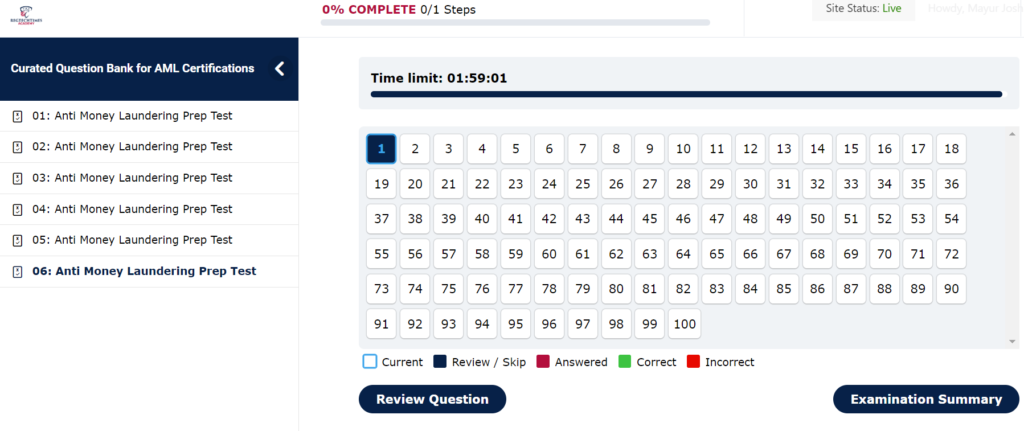
When you log in to the Riskpro website, you’ll see a dashboard with six practice exams. These exams are designed to be like the real exam you’ll take. The questions in the exams are divided into different categories that cover specific topics.

Exam Summary Table

When you begin a practice exam, you will come across a summary table that provides an overview of your progress in the exam. This table helps you track how well you are doing as you navigate through the exam.

CAMP Simulated Exam Dashboard

During the preparation process, you have the option to leave certain questions unanswered and review them later. These unanswered questions are indicated by a dark blue color in the summary table. This allows you to easily identify the questions you need to revisit.

  • Questions that you have answered are indicated by a dark red color in the summary table. This helps you distinguish the questions you have already addressed.
  • If you have answered a question correctly, it will be shown in green color in the summary table. This indicates that you have provided the right answer.
  • On the other hand, if you have answered a question incorrectly, it will be displayed in red color in the summary table. This alerts you to the questions where you may have made an error in your response.

As you progress through the exam and answer questions, the colors of the numbers in the table will change accordingly. This visual representation serves as a quick reference to assess the status of your answers and helps you stay organized during the exam.

By monitoring the changing colors in the summary table, you can easily track your progress, identify unanswered or incorrect questions, and make informed decisions about managing your time effectively.

Analyzing Correct and Incorrect Answers

CAMP Simulated Exams act as the tool to assess exam readiness. It is a valuable tool designed to evaluate your level of preparedness for the exam. It helps you assess your knowledge and skills, identify areas where you excel, and pinpoint areas that may require further attention.

CAMP Simulated Exams Summary

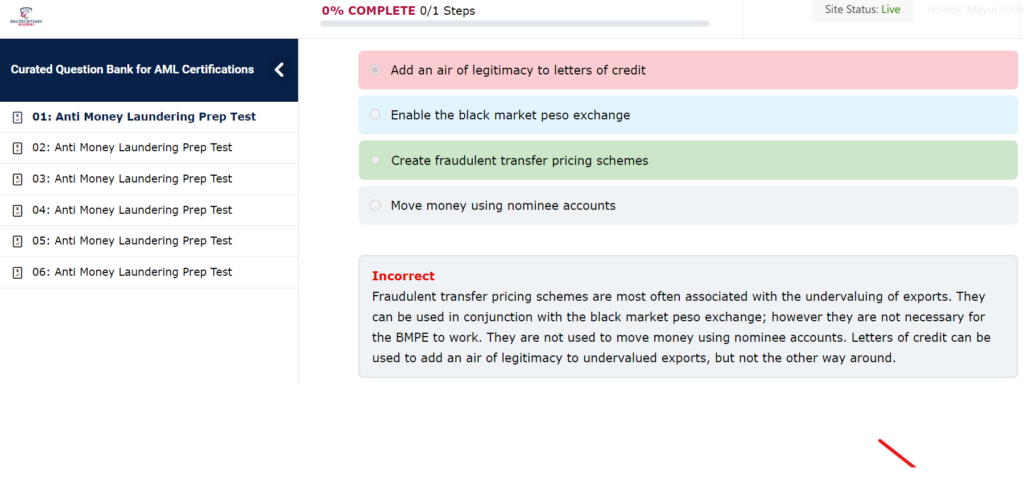
The practice exam tool is extremely beneficial for students as it not only informs you when you provide an incorrect answer to a question but also provides a comprehensive explanation. This feature simplifies the preparation process by offering you a clear understanding of why your answer was incorrect.

When you encounter a question that you have answered incorrectly, the practice exam tool goes beyond simply indicating that it is the wrong answer. It provides you with a detailed explanation that helps you grasp the concept or topic related to that question. This explanation helps you learn from your mistakes and enhances your understanding of the subject matter.

By offering these explanations, the practice exam tool acts as a valuable learning resource. It allows you to identify and rectify any misconceptions or gaps in your knowledge. This way, you can continuously improve your understanding of the material and enhance your exam readiness.

The availability of comprehensive explanations for incorrect answers ensures that you not only memorize correct responses but also comprehend the underlying concepts. This promotes a deeper understanding of the subject matter and increases your chances of performing well in the actual exam.

On Completion of CAMP Simulated Exams

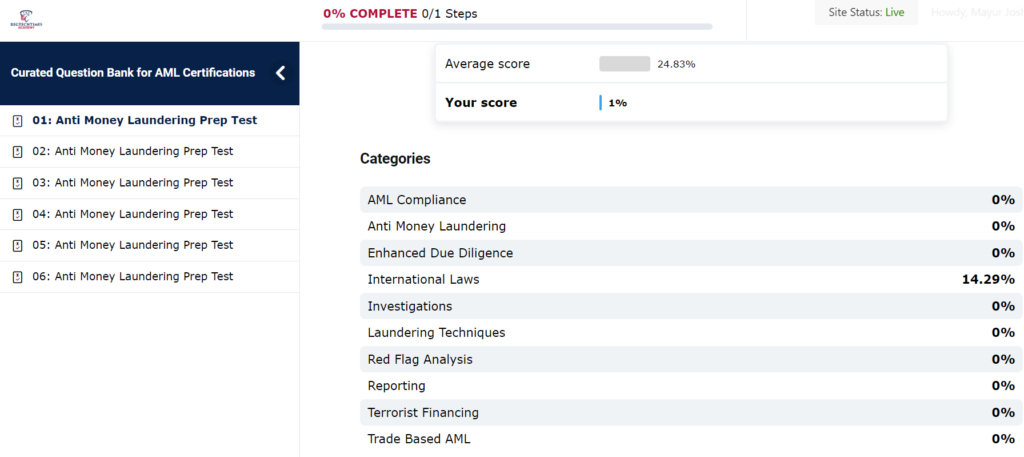
After you have finished answering all the questions in the practice exam, you will be able to view the analysis of your performance. This analysis consists of two main parts.

CAMP Simulated exams category

The first part compares your score with the scores of all the other participants who have completed the simulation. This benchmarking helps you understand how well you performed in relation to others. It provides a reference point to gauge your progress and see where you stand among your peers. You can read about the categories here

The second part of the analysis focuses on identifying the areas where you need to improve. It highlights specific categories or topics where you may have struggled or scored lower. This information gives you valuable insights into the areas that require more attention and further study. By focusing on these areas, you can strengthen your knowledge and increase your chances of performing better in the actual exam.


error: Content is protected !!