

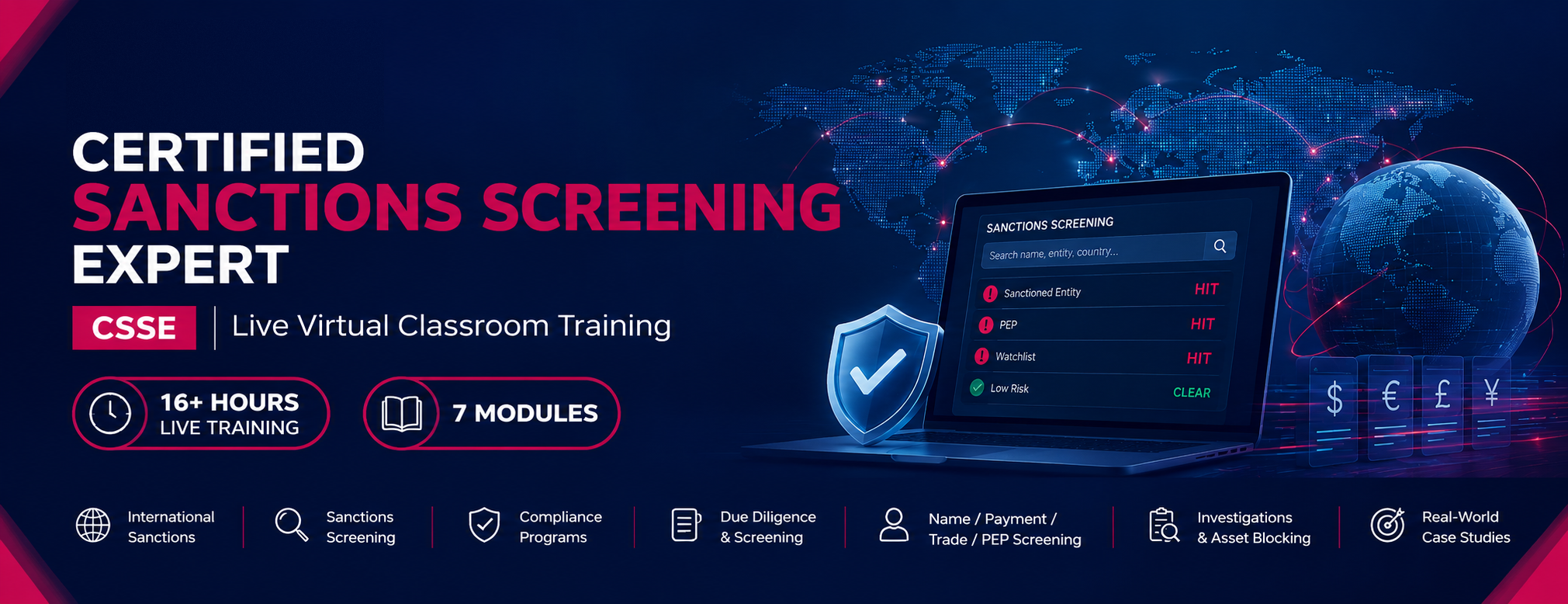
Certified Sanctions Screening Expert (CSSE)
CSSE (Certified Sanctions Screening Expert) is Riskpro Learning's advanced sanctions-screening certification, covering the full workflow from an initial list hit through investigation, evasion-pattern recognition, and filing.
Reviewed by Vedant Sangit, Instructor.
Certified Sanctions Screening Expert (CSSE) is a professional certification program offered through Riskpro Learning that focuses on sanctions screening, sanctions-list identification, screening controls, compliance obligations, false-positive handling and practical sanctions-risk management.
The Certified Sanctions Screening Expert (CSSE) program trains compliance professionals to run a real sanctions-screening desk: the fundamentals of sanctions regimes and compliance program design, hands-on sanctions due diligence, risk tolerance and alert-scoring tools (AST) and screening algorithms, the components of a screening system, and how to recognize and investigate sanctions evasion through to asset freezing and reporting. Every module ends in a graded quiz, a comprehensive final exam is required for certification, and the course is paired with a live CSSE Sanctions Screening Simulation (also referred to as the CSSE Sanctions Investigation Simulator) built on training scenarios modeled on real-world sanctions-screening patterns.
At a glance
- Certification
- Certified Sanctions Screening Expert (CSSE)
- Provider
- Riskpro Learning
- Format
- Self-paced online certification
- Modules
- 4
- Video lessons
- 10
- Learning content
- 21h 31m
- Practical component
- CSSE Sanctions Screening Simulation
- Case library
- 45 sanctions scenarios
- Assessment
- Module quizzes, a comprehensive final examination, and the graded CSSE Sanctions Screening Simulation
- Certificate
- Included
- Access
- Lifetime
- Price
- $499 one-time
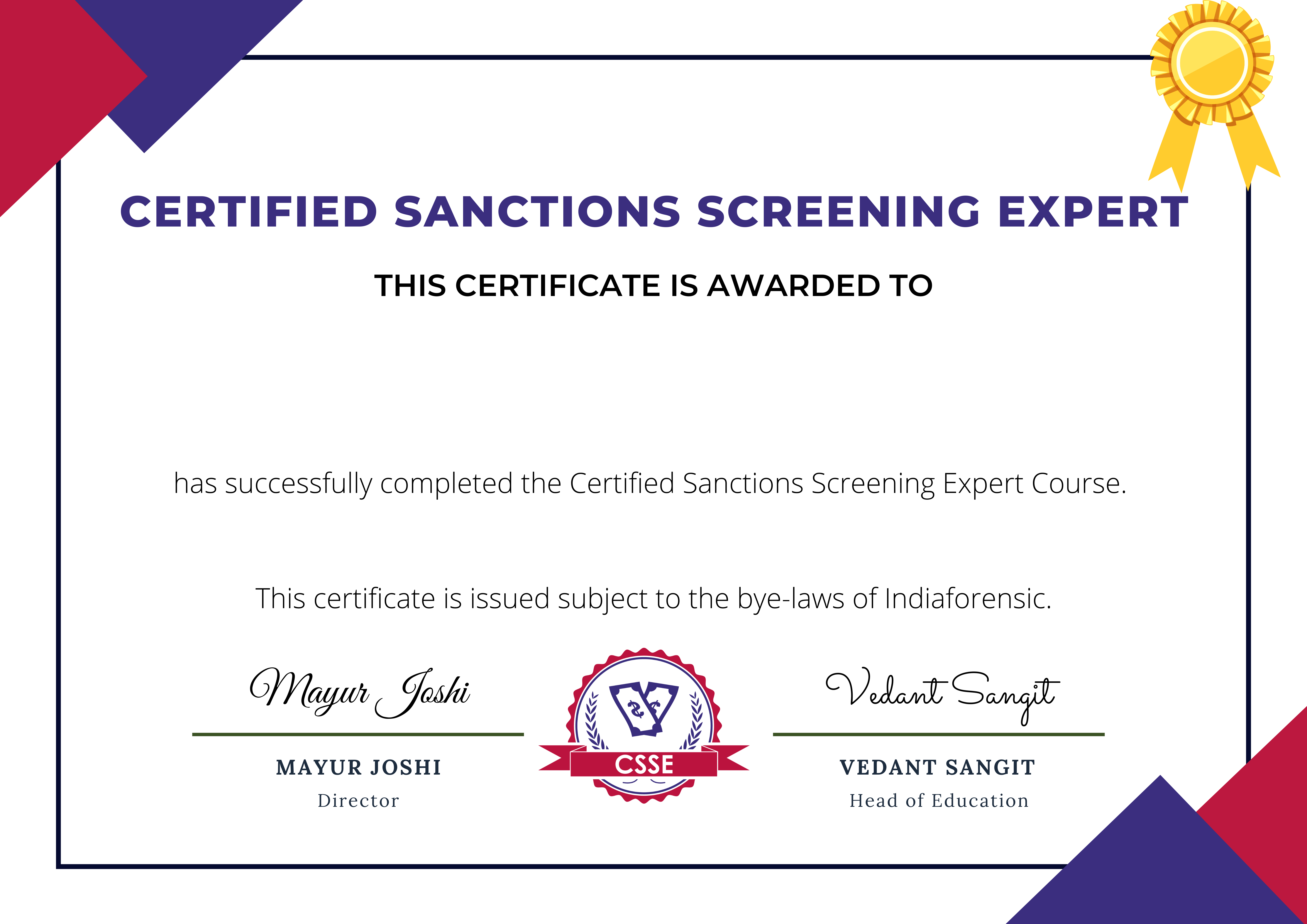
This is what you'll walk away with
A named certificate the moment you complete every module and pass the final examination — issued automatically, no waiting on manual review.
- ✅ Your full name, printed automatically the moment you qualify
- ✅ Downloadable as a PDF
- ✅ Shareable directly to your LinkedIn profile's License & Certifications section
- ✅ Issued with a unique certificate ID, verifiable by any third party
- ✅ No manual review or waiting period — issued the instant you pass
What You'll Learn
Video lessons are the theory half of this certification. The other half is a live, graded sanctions-screening simulation: L1 alert triage, L2 investigation and RFI, and an L3 sanctions-filing report.
1Sanctions Fundamentals 4h 30m
- Basics of Sanctions
- Sanctions Compliance Program
2Screening & Due Diligence 5h 52m
- Sanctions Due Diligence Part 1
- Sanctions Due Diligence Part 2
- Components of Sanctions Screening
3Investigation, Evasion & Enforcement 11h 9m
- Risk Tolerance, ASTs and Algorithms
- Unmasking Sanctions Evasion
- Mastering Sanctions Investigations
- Asset Freezing
4Simulation Lab CSSE Sanctions Screening Simulation
CSSE Sanctions Screening Simulation is the practical, graded core of this certification: every CSSE candidate works a live simulation against a 45-scenario library of training scenarios modeled on real-world sanctions-screening red flags and evasion patterns, triaging alerts at L1, investigating and requesting information at L2, and filing the sanctions/blocking report at L3 — every stage scored automatically against that scenario's own facts. This is what sets CSSE apart from a video-only course.
Frequently Asked Questions
What is sanctions screening?
Sanctions screening is the compliance control that checks a customer, counterparty, or transaction against government and international sanctions lists -- such as OFAC's SDN and SSI Lists, the EU Consolidated List, and UN Security Council sanctions lists -- to catch dealings with a designated person or designated entity before they happen.
What does a sanctions screening professional do?
A sanctions screening professional triages list hits produced by name screening and transaction screening (evaluating match quality, ruling out false positives), investigates ambiguous alerts (alert investigation, including requesting further identifiers), examines ownership and control structures where evasion is suspected, and escalates and files the required sanctions/blocking report on any confirmed match within the applicable deadline.
What does the CSSE certification cover?
Four modules: Sanctions Fundamentals (sanctions regimes and compliance programme design); Screening & Due Diligence (the screening process, matching algorithms, and due diligence practice); Investigation, Evasion & Enforcement (sanctions evasion typologies, alert investigation, and asset freezing); and the CSSE Sanctions Screening Simulation itself -- the practical, graded component that most distinguishes CSSE from a video-only course.
Which sanctions regimes does CSSE address?
CSSE's screening and escalation content is built around the major sanctions authorities a screening analyst actually works against: U.S. OFAC programs (the SDN and SSI Lists), UN Security Council sanctions, the EU Consolidated List, and UK sanctions administered by HM Treasury's OFSI -- covering designated persons and designated entities across these jurisdictions, plus the recognized patterns used to evade detection under them.
Who Should Take the CSSE Certification?
- Sanctions compliance — the full screening-to-filing workflow taught across all four modules
- AML and financial crime compliance — sanctions screening is a core AML/CFT control, and CSSE is built as a complement to broader AML training
- KYC and customer due diligence — customer screening and ownership-and-control due diligence run throughout the curriculum
- Transaction screening — transaction-screening mechanics and matching are covered directly in Screening & Due Diligence
- Sanctions investigations — alert investigation and evasion-typology recognition are a dedicated module, practiced in the CSSE Sanctions Screening Simulation
- Trade compliance — trade-finance compliance staff are named directly in the course's own audience description
- Correspondent banking compliance — correspondent banking compliance staff are named directly in the course's own audience description
- Financial crime operations — the alert triage, escalation, and filing workflow mirrors a financial-crime operations function's day-to-day work
- Compliance risk management — Sanctions Fundamentals covers sanctions-compliance-programme design, not just alert-level analyst tasks
- Sanctions advisory and consulting — the course is built to also suit consultants advising financial institutions on sanctions programmes
Key Terms & Glossary
22 terms used in this course, in plain language.
- OFAC
- The Office of Foreign Assets Control, a U.S. Department of the Treasury agency that administers and enforces most U.S. economic and trade sanctions programs, including maintaining the SDN List.
- SDN List
- The Specially Designated Nationals and Blocked Persons List — OFAC's primary sanctions list, naming individuals and entities whose assets are blocked and with whom U.S. persons are generally prohibited from dealing.
- Sectoral Sanctions Identifications (SSI) List
- A separate OFAC list of persons subject to more limited, activity-specific restrictions (e.g. dealing in new debt or equity of a specified tenor) rather than a full SDN-style asset freeze.
- EU Consolidated List
- The European Union's single consolidated list of persons, groups and entities subject to EU financial sanctions.
- UN Security Council Sanctions List
- Sanctions lists maintained by UN Security Council committees (e.g. the 1267, 1718, and 1988 Committees) under binding UN resolutions, which UN member states are obligated to implement domestically.
- Blocking Sanctions
- A sanctions program requiring a full freeze of a designated person's property and interests in property, and prohibiting virtually all dealings with them absent a license.
- Sectoral Sanctions
- A sanctions program restricting only specified categories of dealing (e.g. new debt/equity financing) with a designated person, who is not otherwise fully blocked — a narrower, more surgical restriction than a blocking program.
- Specific License
- An authorization issued to a named applicant, after individual application and review, permitting a particular otherwise-prohibited transaction or set of transactions.
Show all 22 terms
- General License
- A standing authorization for a defined category of otherwise-prohibited transactions, available to anyone who meets its stated conditions without an individual application.
- Secondary Sanctions
- Measures that can expose non-U.S. (third-country) persons to sanctions risk, or restricted access to a jurisdiction's financial system, for engaging in significant transactions with a sanctioned party — extending a program's practical reach beyond direct jurisdictional nexus.
- Screening Algorithm
- The matching logic a screening system applies when comparing a party name (or other identifier) against a sanctions list — ranging from exact string matching to fuzzy, phonetic, or transliteration-aware matching, each trading off missed true matches against false-positive volume differently.
- Fuzzy Matching
- A matching technique (e.g. Levenshtein edit distance) that flags names similar to, but not identical to, a list entry — catching misspellings, transliteration variants, or deliberately altered spellings that an exact match would miss.
- Transliteration
- The process of rendering a name originally written in one script (e.g. Cyrillic, Arabic) into another (typically Latin), which can legitimately produce multiple different correct spellings of the same underlying name — a major source of screening false positives and a vector for deliberate evasion.
- Name Order Variance
- The fact that given-name/family-name ordering and conventions differ across cultures and naming systems, which a screening algorithm must account for so a legitimate match in a different name order isn't missed.
- True Match
- A screening alert where investigation confirms the screened party is, in fact, the sanctioned person or entity named on the list.
- False Positive
- A screening alert where the screened party is, on investigation, determined NOT to be the sanctioned person or entity on the list — the match was coincidental (e.g. a shared common name) rather than the same real-world party.
- List Hit
- The initial, unresolved output of a screening system: a name (or other identifier) in a transaction or customer record scored as sufficiently similar to a list entry to warrant human review — not yet a determination of true match or false positive.
- PEP
- Politically Exposed Person — an individual holding (or closely associated with someone holding) a prominent public function, a risk factor related to, but distinct from, sanctions screening: PEP status can heighten scrutiny and inform enhanced due diligence, though not every PEP is sanctioned and not every sanctioned person is a PEP.
- Asset Freezing
- Segregating a designated person's assets and placing them beyond their use or control, without transferring ownership — the institution holds the assets blocked, pending further legal process, license, or resolution of the underlying sanctions designation.
- De-risking
- An institution's decision to wholesale exit or avoid entire categories of customers or business rather than manage sanctions/AML risk on a case-by-case basis — generally discouraged by regulators as a blunt response that can harm financial inclusion without improving actual compliance outcomes.
- Wolfsberg Sanctions Screening Principles
- Industry-recognized good-practice principles, published by the Wolfsberg Group, for how financial institutions should design, tune, and govern sanctions screening programs.
- Evasion Typology
- A recognized pattern by which a sanctioned party (or someone acting on their behalf) attempts to avoid detection by a screening program — e.g. name/transliteration manipulation, shell entities, structuring, or third-country routing — rather than an isolated, one-off anomaly.
No term matches that search.
Summary & Key Takeaways
CSSE is Riskpro Learning's advanced sanctions-screening certification, built around a 45-scenario case library and the live, graded CSSE Sanctions Screening Simulation. Per OFAC's own published sanctions-compliance guidance (ofac.treasury.gov) and FATF's 40 Recommendations (fatf-gafi.org), sanctions screening against lists such as the SDN List is a core AML/CFT control, not an optional add-on. The course is reviewed by Vedant Sangit, its Instructor, and leads to a certificate carrying a unique, third-party-verifiable ID.
References & Further Reading
Official sources
- OFAC (US Treasury Office of Foreign Assets Control) — Maintains the Specially Designated Nationals (SDN) list and the Sectoral Sanctions Identifications (SSI) list.
- FATF (Financial Action Task Force) -- the 40 Recommendations — The global standard-setting body for AML/CFT, including sanctions-related expectations.
- The Wolfsberg Group -- Sanctions Screening Principles — Industry-recognized good-practice principles for sanctions screening programs.
Further reading
- Mastering Sanctions Screening: Essential Guide for the CSSE Exam Indiaforensic — Study guide to the topics the CSSE covers.
- Sanction Risk Assessment: A 10-Step Guide RegTech Times — How to assess an institution's sanctions risk.
- Sanctions Due Diligence: Guide for Three Kinds of Business RegTech Times — Applying sanctions due diligence in practice.
- Transaction Screening to Identify PEPs RegTech Times — Screening payments for politically exposed persons.
- New OFAC Advisory: Hidden Asset Control in Sanctions Evasion RegTech Times — A recent evasion pattern screening teams are told to watch for.
Our Other Courses
Certified Anti Money Laundering Professional (CAMP)
CAMP — Certified Anti-Money Laundering Professional is Riskpro Learning's practitioner-track AML/CFT certification, pairing a full video curriculum with a hands-on investigation simulator.The video lessons cover the risk-based approach, transaction monitoring and regulatory reporting, sanctions and PEP screening, money service businesses, virtual assets, trade-based laundering, and shell-company red flags.The simulator is the practical half of the certification: you work a live alert queue, escalate and manage real-style cases, and write the narrative for a regulatory filing, exactly as an AML analyst or investigator would.Every learning module ends with a short, timed practice quiz (up to 3 attempts) so you can check your own understanding along the way.
Explore Certified Anti Money Laundering Professional (CAMP) →Certified Forensic Accounting Professional (CFAP)
CFAP (Certified Forensic Accounting Professional) is a forensic accounting and fraud investigation certification awarded by the Indiaforensic Center of Studies and delivered globally in partnership with Riskpro Learning, covering forensic audit, fraud detection, and investigative report writing.
Explore Certified Forensic Accounting Professional (CFAP) →Register for Certified Sanctions Screening Expert (CSSE)
Tell us a bit about yourself, complete secure payment via Stripe, and you'll get instant access to the course — no waiting, no manual approval, and no separate form to fill in afterward.
$499 one-time payment · lifetime access
Already registered? Log in here.