
Certified Anti Money Laundering Professional (CAMP)
CAMP (Certified Anti Money Laundering Professional) is Riskpro Learning's practitioner-track AML/CFT certification, combining a full video curriculum with a live, graded alert-investigation simulation.
CAMP is an AML/CFT professional certification created and delivered by Riskpro Learning/Risk Academy. Its distinctive feature is a graded practical investigation simulation covering L1 alert investigation, L2 case management and L3 SAR/STR narrative writing. It combines 68 on-demand lessons across 11 modules with practical assessment and a final examination. Its supporting educational resources include an AML/CFT glossary, AML typology and transaction-monitoring rules reference, and SAR/STR writing guide.
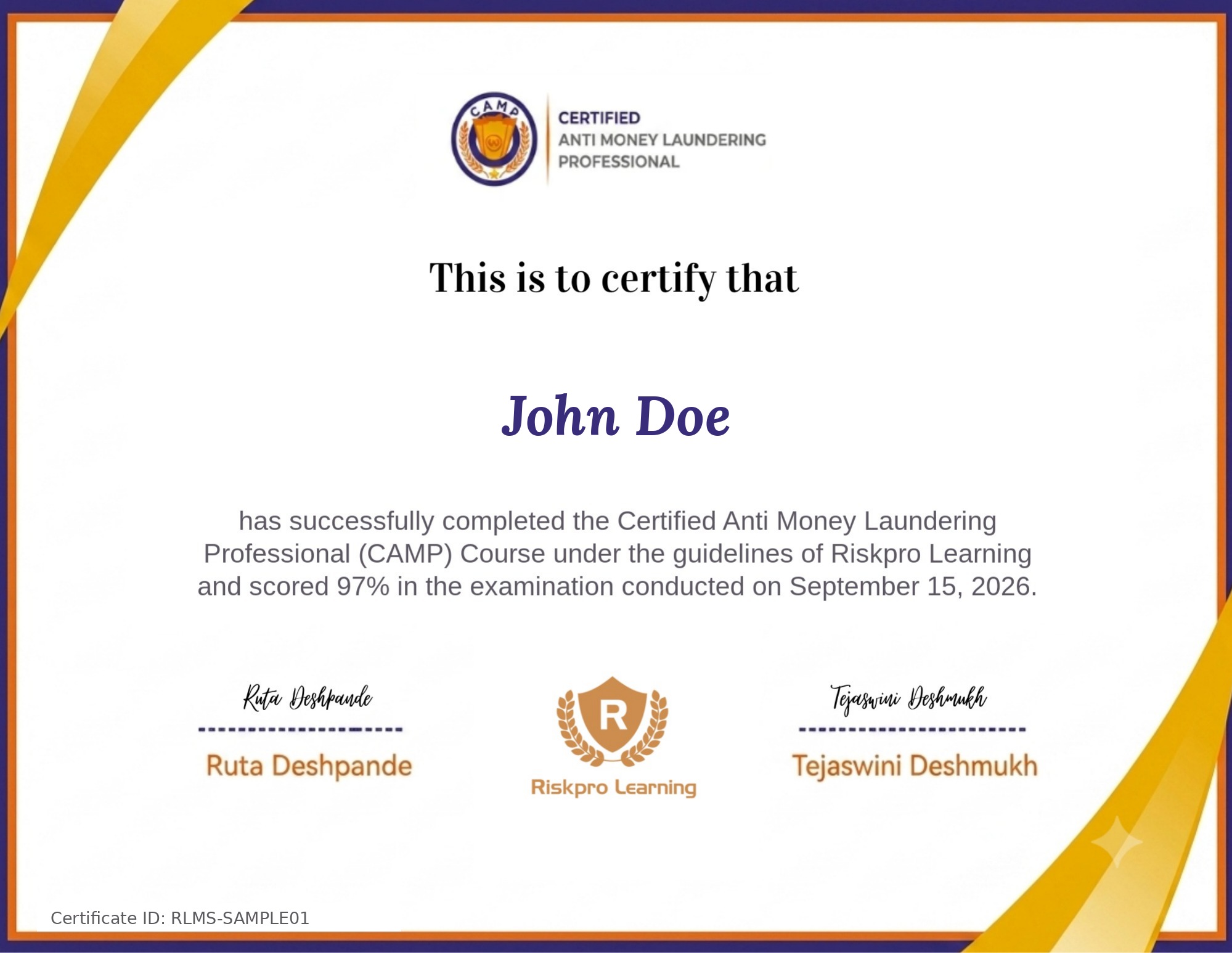
This is what you'll walk away with
A named certificate the moment you complete every module and pass the final examination — issued automatically, no waiting on manual review.
- ✅ Your full name, printed automatically the moment you qualify
- ✅ Downloadable as a PDF
- ✅ Shareable directly to your LinkedIn profile's License & Certifications section
- ✅ Issued with a unique certificate ID, verifiable by any third party
- ✅ No manual review or waiting period — issued the instant you pass
What You'll Learn
Video lessons are the theory half of this certification. The other half is a live, graded alert-investigation simulation where you work a real-style case queue end to end -- the part that sets CAMP apart from a plain video course.
1Foundations of AML & KYC 12 min
- What is CAMP?
- CAMP What is AML?
- CAMP What is KYC?
- CAMP Know Your Customer in Detail
- CAMP AML V/s KYC
2The Risk-Based Approach (RBA) 18 min
- CAMP RBML Introduction
- CAMP Risk Based Approach to AML
- CAMP How does Risk Based Approach Work?
- CAMP Two Pillars of RBML
- CAMP Customer Risk Profiling
3Transaction Monitoring & Regulatory Reporting 18 min
- CAMP Understanding Red Flags
- CAMP Transaction Monitoring
- CAMP When to file the STR
4PEP, Sanctions & Adverse Media Screening 18 min
- CAMP Screening Against the PEP List
- CAMP PEP Modus Operandi
- CAMP Foreign PEP
- CAMP Sanction Screening
- CAMP Adverse Media
- CAMP Real Estate High Risk Business
5Money Service Businesses (MSBs) 30 min
- CAMP What are MSB'S
- CAMP MSB History
- CAMP AML Perspective for MSB'S
- CAMP MSB Record Keeping
- CAMP Suspicious Transaction MSB
- CAMP AML Scenerio MSB
- … and 2 more
6AI & Automation in AML: RPA, ML & NLP 16 min
- CAMP Applying RPA
- CAMP Natural Language
- CAMP Machine Learning in Anti Money Laundering
- CAMP Data Cleaning
- CAMP Application of Machine Learning
7Virtual Assets, Crypto & Darknet Laundering 30 min
- CAMP Introduction to Crypto Asset
- CAMP What are the crimes in crypto?
- CAMP Crypto Laundering through Money Mules
- CAMP Laundering through Crypto Exchanges
- CAMP Darknet and Deepnet
- CAMP Underground Marketplace
- … and 2 more
8Trade-Based Money Laundering (TBML) 47 min
- CAMP Understanding the Trade Finance
- CAMP Understanding Letter of Credit
- CAMP Understanding International Trade
- CAMP TBML Techniques Invoice Manipulation
- CAMP Mechanism of TBML
- CAMP Introduction to TBML
- … and 8 more
9Real-World Case Studies & Regulatory Enforcement 25 min
- CAMP Troika Laundering
- CAMP Biggest fines on Banks due to KYC
- CAMP 1MDB Scandal
- CAMP Fincen Files
- CAMP Commonwealth Bank of Australia
- CAMP European Laundering
10Shell Companies & High-Risk Corporate Structures 18 min
- CAMP Web of Companies
- CAMP Uses of Paper Companies
- CAMP Shell Companies
- CAMP How to Identify Shell Companies
- CAMP Red Flags of Shell Companies
11Simulation Lab CAMP AML Investigation Simulator
- L1 Investigations: Live Alert Queue
- L2 Case Management: Escalated Investigations
- L3 Narrative Lab: Regulatory Reporting
Frequently Asked Questions
What is CAMP?
CAMP (Certified Anti Money Laundering Professional) is Riskpro Learning's AML/CFT compliance certification: 68 on-demand video lessons across 11 modules (10 content modules plus the graded Simulation Lab module), and a final examination, leading to a certificate on completion.
Do I get a certificate?
Yes — a certificate is issued on completing every module and passing the final examination.
How do I get access after paying?
Payment is processed securely by Stripe. Access is granted automatically and immediately once payment is confirmed — no manual approval or waiting period.
Is CAMP a practical AML certification?
Yes -- alongside the video curriculum and final exam, every CAMP candidate works the CAMP AML Investigation Simulator, a graded case-investigation exercise covering 150+ realistic alerts, and receives the resulting gradebook alongside their certificate as evidence of practical, hands-on performance.
Is CAMP by Risk Academy the same as other certifications called CAMP?
No. More than one provider uses the name "Certified Anti-Money Laundering Professional (CAMP)". This CAMP is offered by Risk Academy, the global initiative of Riskpro Learning (the training vertical of Riskpro Management Consulting Pvt. Ltd.), and is the one assessed through the CAMP AML Investigation Simulator. Every certificate carries a unique verification ID that can be checked on the certificate verification page of this site.
Key Terms & Glossary
All Terms
- AML
- Anti-Money Laundering — the laws, regulations and controls a financial institution runs to prevent, detect and report the movement of illicit funds through its products.
- CFT
- Countering the Financing of Terrorism — the parallel discipline to AML focused specifically on funds intended to support terrorist activity, often bundled together as "AML/CFT."
- CAMP
- Acronym for Certified Anti Money Laundering Professional. It is the certification course offered by Riskpro learning which provides simulation labs for the AML professionals to work in the real life investigation environment.
- KYC
- Know Your Customer — the process of verifying a customer's identity and understanding the nature of their expected activity at onboarding.
- CDD
- Customer Due Diligence — the standard level of KYC information and ongoing monitoring applied to every customer, risk-rated to match their profile.
- EDD
- Enhanced Due Diligence — a deeper level of scrutiny applied to higher-risk customers (e.g. PEPs, high-risk jurisdictions), involving additional evidence gathering and more frequent review.
- PEP
- Politically Exposed Person — an individual who holds, or has held, a prominent public function, or their immediate family/close associates, carrying elevated corruption risk.
- UBO
- Ultimate Beneficial Owner — the natural person(s) who ultimately own or control a legal entity, even if the ownership is structured through intermediary companies or nominees.
- SAR
- Suspicious Activity Report — a confidential report filed with a financial intelligence unit when an institution has reasonable grounds to suspect a transaction or relationship is linked to criminal activity.
- STR
- Suspicious Transaction Report — the term used in many non-US jurisdictions for the same filing concept as a SAR.
- CTR
- Currency Transaction Report — a mandatory report filed whenever a cash transaction (or series of related transactions) crosses a statutory threshold, regardless of whether it looks suspicious.
- EFTR
- Electronic Funds Transfer Report — a mandatory report on qualifying electronic transfers above a threshold, analogous to a CTR but for wire/EFT activity rather than cash.
- FIU
- Financial Intelligence Unit — the national government body that receives SARs/STRs from institutions, analyses them, and can pass actionable intelligence to law enforcement.
- MLRO
- Money Laundering Reporting Officer — the senior individual formally designated as responsible for an institution's AML programme, including SAR filing decisions.
- RFI
- Request for Information — a formal question sent to a relationship manager or, carefully, the customer, to resolve an open concern before a disposition is made.
- Tipping-off
- Illegally alerting a customer (directly or indirectly) that they are, or may be, the subject of a suspicious activity investigation or report — a criminal offence in most jurisdictions.
- Four-Eyes / Maker-Checker
- A control requiring that the person who recommends a decision cannot also be the person who approves it — a second, independent reviewer must sign off.
- FATF
- Financial Action Task Force — the global standard-setting body for AML/CFT policy; most national regulations are built around its 40 Recommendations.
- OFAC
- Office of Foreign Assets Control — the US Treasury body that administers and enforces US economic and trade sanctions, including the SDN List.
- SDN List
- Specially Designated Nationals List — OFAC's list of individuals and entities with whom US persons are generally prohibited from dealing.
- Placement
- The first stage of money laundering: introducing illicit cash into the financial system, e.g. via cash deposits.
- Layering
- The second stage: moving funds through multiple transactions, accounts or jurisdictions to obscure their origin.
- Integration
- The third stage: reintroducing laundered funds into the legitimate economy, e.g. via investments or purchases, so they appear clean.
- Structuring / Smurfing
- Breaking a large sum into multiple smaller transactions, each below a reporting threshold, to avoid triggering mandatory reporting.
- TBML
- Trade-Based Money Laundering — disguising criminal proceeds by misrepresenting the price, quantity or quality of goods in trade documentation.
- Shell Company
- A legal entity with no genuine business activity, employees or physical operations, often used to obscure the true source or owner of funds.
- Funnel Account
- An account that receives many small deposits from dispersed sources and consolidates them into large outbound transfers.
- Money Mule
- An individual (often unwittingly) who allows their account to be used to receive and forward funds on behalf of a criminal network, usually in exchange for a small fee.
- Nested Account
- A situation where a respondent bank allows a third bank to use its correspondent account without the correspondent institution's knowledge or approval.
- VASP
- Virtual Asset Service Provider — a business (exchange, custodian, etc.) that conducts activities involving virtual assets on behalf of customers, subject to its own AML obligations.
- Travel Rule
- The requirement that originator and beneficiary information travel with a funds transfer (including virtual asset transfers) so it can be screened at each step.
- Red Flag
- An individual indicator (not on its own proof of wrongdoing) that, especially in combination with others, raises the likelihood a transaction or relationship is suspicious.
- Typology
- A recognised pattern or method by which money laundering or terrorist financing is typically carried out, used to design detection rules and train investigators.
- Risk-Based Approach
- Allocating AML resources and control intensity in proportion to the actual money-laundering/terrorist-financing risk a customer, product or relationship presents.
- Source of Funds
- The origin of the specific funds involved in a particular transaction or relationship (e.g. "salary," "sale of property").
- Source of Wealth
- The origin of a customer's entire net worth accumulated over time, a broader concept than source of funds, typically required for higher-risk/PEP relationships.
- De-Risking
- An institution exiting or declining entire categories of customers or business considered too high-risk to manage, rather than managing the risk on a case-by-case basis.
- Watchlist
- A maintained list (sanctions, PEP, internal hotlist, adverse media) screened against customer and transaction data to surface potential matches.
- Escalation
- Formally routing a case to a more senior or specialised reviewer (e.g. L1 to L2, L2 to L3/MLRO) because it needs deeper investigation or higher authority to close.
- Disposition
- The final decision recorded against an alert or case (e.g. cleared, escalated, SAR filed) along with the rationale supporting it.
- Reasonable Grounds to Suspect
- The legal threshold in most jurisdictions for filing a SAR/STR — a level below certainty or proof, but more than a vague hunch, grounded in specific, articulable facts.
- Adverse Media
- Credible negative news coverage about a customer or associated party, screened for links to financial crime, corruption or other predicate offences.
- Correspondent Banking
- An arrangement where one bank (the correspondent) provides services to another bank (the respondent) to give it access to markets or currencies it can't reach directly.
Summary & Key Takeaways
CAMP combines 68 video lessons across 11 modules with the CAMP AML Investigation Simulator, a live, graded case-investigation exercise, and a final examination. Per FATF's 40 Recommendations (fatf-gafi.org), the global AML/CFT standard most national regulators implement, the risk-based approach and SAR/STR-style reporting CAMP teaches are core expectations of any compliance programme. A certificate, carrying a unique, third-party-verifiable ID, is issued once every module, the simulator, and the final exam are complete.
References & Further Reading
- FATF (Financial Action Task Force) -- the 40 Recommendations — The global standard-setting body for AML/CFT, whose 40 Recommendations most national AML regimes implement.
- FinCEN (US Treasury Financial Crimes Enforcement Network) — Sets Suspicious Activity Report (SAR) requirements for US financial institutions.
- OFAC (US Treasury Office of Foreign Assets Control) — Maintains the Specially Designated Nationals (SDN) list and sanctions-compliance guidance.
- The Wolfsberg Group — Publishes widely-used AML principles for correspondent banking.
- RBI (Reserve Bank of India) -- Master Directions on KYC — Governs Indian banks' AML/KYC obligations.
Our Other Courses
Certified Sanctions Screening Expert (CSSE)
CSSE (Certified Sanctions Screening Expert) is Riskpro Learning's advanced, standalone certification in sanctions screening -- covering the full workflow from an initial list-hit through investigation, evasion-pattern recognition, and filing a sanctions/blocking report, built around a 45-scenario library of training scenarios modeled on real-world sanctions-screening patterns, and the live, graded CSSE Sanctions Screening Simulation.
Explore Certified Sanctions Screening Expert (CSSE) →Certified Forensic Accounting Professional (CFAP)
CFAP (Certified Forensic Accounting Professional) is a forensic accounting and fraud investigation certification awarded by the Indiaforensic Center of Studies and delivered globally in partnership with Riskpro Learning, covering forensic audit, fraud detection, and investigative report writing.
Explore Certified Forensic Accounting Professional (CFAP) →Register for Certified Anti Money Laundering Professional (CAMP)
Tell us a bit about yourself, complete secure payment via Stripe, and you'll get instant access to the course — no waiting, no manual approval, and no separate form to fill in afterward.
$499 one-time payment · lifetime access
Already registered? Log in here.