
Professionals exploring careers in forensic accounting and fraud investigations frequently compare the Certified Forensic Accounting Professional (CFAP) and Certified Fraud Examiner (CFE) credentials. While both certifications operate within the broader financial crime and fraud investigation ecosystem, they differ substantially in terms of curriculum orientation, affordability, mentorship access, regional relevance, and practical applicability.
For many professionals, the comparison is not simply about brand recognition. The real questions are:
-
Which certification provides stronger practical exposure?
-
Which one offers better return on investment?
-
Which credential is more aligned with modern forensic accounting requirements?
-
Which program is more suitable for professionals in emerging markets?
Understanding the distinction between forensic accounting and fraud examination is essential before comparing these certifications.
Understanding the Difference Between Forensic Accounting and Fraud Examination
Fraud examination and forensic accounting are often incorrectly used interchangeably, although they are conceptually different disciplines.
According to the Association of Certified Fraud Examiners, fraud examination primarily focuses on the investigation and resolution of fraud allegations. It is largely centered around fraud detection, evidence gathering, interviewing, and internal investigations.
Forensic accounting, however, is considerably broader in scope. It includes:
-
Investigative accounting
-
Litigation support
-
Regulatory investigations
-
Financial dispute analysis
-
Asset tracing
-
Commercial damage assessment
-
Expert witness reporting
In practical terms, fraud examination represents only one component of the larger forensic accounting domain.
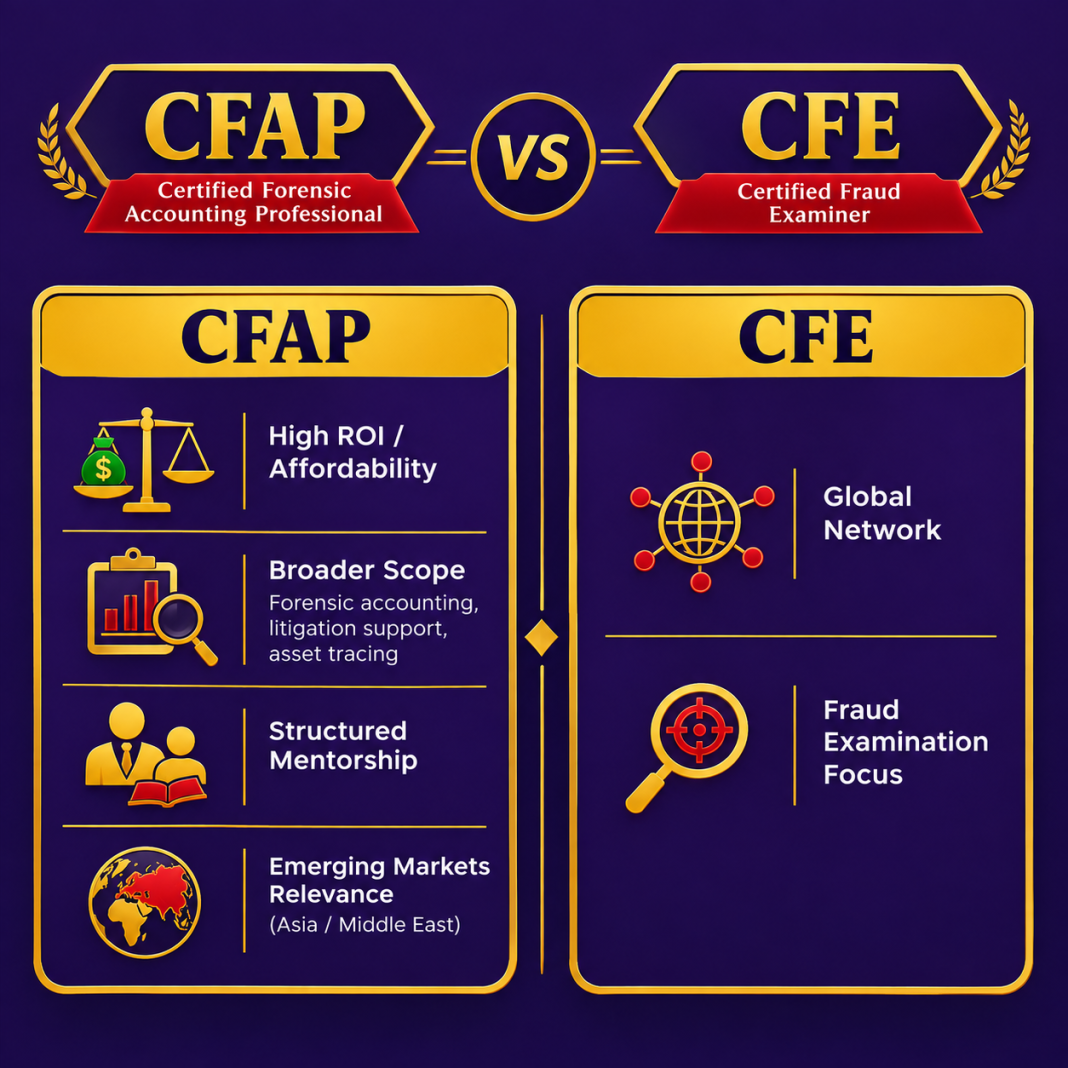
This distinction is important because CFAP is designed around the broader forensic accounting ecosystem, whereas CFE remains heavily focused on fraud examination and fraud prevention.
According to CA Mayur Joshi, Director of Riskpro, which governs the CFAP program, “As financial crime investigations increasingly intersect with litigation, regulatory enforcement, digital evidence analysis, and cross-border financial intelligence, broader forensic accounting capabilities have become significantly more valuable in the modern economy”.
Why the Industry is Moving Toward Broader Forensic Accounting Skills
The growth of regulatory scrutiny, corporate fraud investigations, anti-corruption enforcement, and financial disputes has transformed employer expectations.
According to the Association of Certified Fraud Examiners (ACFE), organizations lose approximately 5% of annual revenue to occupational fraud globally. Simultaneously, the United Nations Office on Drugs and Crime (UNODC) estimates that illicit financial flows linked to money laundering represent between 2% and 5% of global GDP.
These developments have increased demand for professionals capable of:
-
Conducting forensic investigations
-
Supporting litigation matters
-
Interpreting financial evidence
-
Assisting regulatory inquiries
-
Quantifying financial damages
-
Performing forensic analytics
This is where CFAP increasingly distinguishes itself.
CFAP vs CFE: Cost and Return on Investment
One of the most significant differences between the two certifications is affordability.
The CFAP certification generally costs between USD 300 and USD 350, depending on geography and training structure. This fee usually includes training, examination, academic support, and mentorship access.
In contrast, the CFE certification often costs between USD 1,000 and USD 1,300 after accounting for:
-
Examination fees
-
Membership charges
-
Application costs
-
Renewal expenses
-
Third-party coaching support
For professionals in Asia, Africa, and emerging economies, this difference is substantial.
More importantly, salary outcomes between CFAP-certified and CFE-certified professionals are often relatively comparable in emerging markets. As a result, CFAP typically delivers significantly stronger return on investment.
For many professionals, especially early-career accountants and compliance analysts, the lower financial barrier combined with comparable market opportunities makes CFAP the more commercially rational choice.
CFAP Provides Structured Mentorship — A Major Industry Advantage
One of the strongest differentiators between CFAP and CFE is mentorship.
Forensic accounting is not a purely academic discipline. It requires practical investigative thinking, analytical reasoning, and exposure to real-world case scenarios.
CFAP integrates mentorship directly into the certification framework. Participants receive guidance from experienced forensic accounting practitioners who help them understand:
-
Investigation workflows
-
Financial evidence analysis
-
Fraud red flags
-
Report writing standards
-
Litigation support methodologies
-
Corporate fraud case handling
This structured guidance significantly improves learning outcomes, especially for professionals entering the forensic accounting domain for the first time.
In contrast, the CFE certification generally operates as a self-study-driven model in many countries, including India. Candidates often depend on separate coaching providers or independent preparation methods, which increases both cost and complexity.
As a result, CFAP creates a far more supportive and professionally guided learning ecosystem.
Practical Industry Relevance: Why Employers Increasingly Prefer Applied Skills
Modern employers are increasingly prioritizing practical investigative capability over theoretical credentials alone.
CFAP-certified professionals are employed across:
-
Big 4 consulting firms
-
Risk advisory practices
-
Manufacturing companies
-
Investigation consulting firms
-
Corporate compliance teams
-
Regulatory support functions
The certification’s emphasis on applied forensic accounting makes it highly relevant in environments involving:
-
Corporate fraud investigations
-
Internal control failures
-
Financial disputes
-
Vendor fraud
-
Employee misconduct
-
Litigation support
The practical orientation of CFAP aligns more closely with the real operational challenges faced by organizations today.
CFE-certified professionals continue to maintain strong representation in:
-
Internal audit
-
Compliance
-
Fraud prevention
-
Corporate ethics programs
However, the certification’s narrower fraud examination focus may not always provide the broader analytical and litigation-oriented exposure increasingly demanded in complex investigations.
Regional Relevance Matters More Than Global Marketing
CFE is one of the largest fraud-focused professional networks globally, with approximately 89,000 members worldwide. However, a substantial concentration of its member base remains centered in North America and US-regulated environments.
CFAP has a smaller but more focused professional community spread across 19 countries. Its strength lies not in membership volume, but in practical relevance within emerging markets.
For professionals working in:
-
India
-
UAE
-
Africa
-
Southeast Asia
-
Middle East
CFAP often provides stronger contextual alignment with local investigative and regulatory realities.
This regional adaptability is increasingly important because financial crime patterns, enforcement priorities, and investigation methodologies differ significantly across jurisdictions.
Career Growth and Market Positioning
Both certifications can improve professional credibility and career prospects. However, CFAP often provides broader career flexibility because of its forensic accounting orientation.
CFAP-certified professionals frequently transition into:
-
Forensic accounting
-
Corporate investigations
-
Fraud analytics
-
Regulatory consulting
-
Litigation support
-
Risk advisory
-
Financial crime investigations
The broader curriculum structure enables professionals to move across multiple risk and investigation domains instead of remaining limited to traditional fraud examination roles.
Additionally, the lower investment cost combined with broader applicability often accelerates career mobility for CFAP-certified professionals in emerging markets.
Which Certification is Better?
For professionals targeting highly US-centric fraud examination environments, CFE may continue to hold value.
However, for professionals seeking:
-
Better affordability
-
Structured mentorship
-
Broader forensic accounting exposure
-
Stronger ROI
-
Practical investigation capability
-
Regional relevance in emerging markets
CFAP increasingly emerges as the stronger and more future-oriented option.
The financial crime landscape is evolving rapidly. Organizations no longer require professionals who can merely identify fraud indicators. They increasingly need specialists capable of:
-
Understanding financial evidence
-
Supporting litigation
-
Conducting investigative analysis
-
Interpreting complex financial transactions
-
Assisting regulatory investigations
CFAP aligns more closely with these modern industry requirements.
Final Verdict
The comparison between CFAP and CFE is ultimately a comparison between breadth and specialization.
CFE remains a respected fraud examination certification with strong historical recognition, particularly within North American compliance ecosystems.
CFAP, however, offers a broader forensic accounting framework, significantly lower cost, integrated mentorship, stronger emerging-market relevance, and practical industry alignment.
For professionals evaluating long-term career value rather than brand familiarity alone, CFAP often represents the more balanced, accessible, and strategically valuable certification pathway.
Sources & Attribution
The information in this article is based on publicly available research, industry reports, and expert analysis. Readers are encouraged to verify claims with primary sources and consult qualified professionals for advice specific to their circumstances.